(Contains spoilers for Mistborn era 1 and The Alloy of Law.)
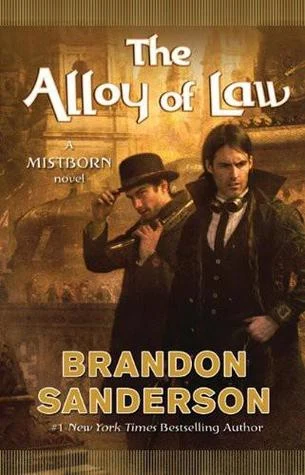
After finishing Yumi, I was debating whether to start Mistborn era 2 before finishing the Stormlight Archive. In the chronology of the Cosmere, era 2 occurs after the events of Stormlight. But in the chronology of our world, it was written first, so most people have some context from it before much of Stormlight. Decision made, I cracked open my copy of The Alloy of Law, happy to stave off the monstrosity that is Wind and Truth for another day.
I knew going into this that era 2 was steampunk. This was promising; I've always been partial to steampunk as an aesthetic. I also love it when a sequel takes an existing world that you've spent a lot of time in and shows its evolution through technological progress. One of my favorite sequels of all time, The Legend of Korra, did this with great success, though in that case the world somehow got to the equivalent of early 20th-century technology. Here the technological progress is more believable, going from around the 16th century to around the 19th century relative to our own, in a similar 300 years in-world.
Knowing Brandon, I'm sure he has a detailed internal justification for the timeline. But it does seem somewhat surprising that a civilization so intimately familiar with metals, their alloys, and their attendant properties wouldn't discover steam power or electricity a little sooner than we did. Perhaps that could be explained by society having to start from scratch following the events of The Hero of Ages.
This is in fact the first series I'm reading where there is such a thing as an era 2. Few writers of epic fantasy manage such a feat given the already massive scale of their stories, but few writers are as prolific as Brandon. Not only is there an era 2 for Mistborn, but an era 3 is in the works as well. Not to mention the second era of Stormlight, which would probably dwarf both eras of Mistborn combined. It's truly astounding, the sheer volume this man can write.
The one other thing I knew about this era was that Vin, Kelsier, and a few others from era 1, following their legendary feats at the end, have understandably been deified and are worshiped in this era as gods. I was quite intrigued to see how he would handle this. Brandon puts a lot of care and thought into the religions in his books, almost all of them having a few, and some a lot more.
One can assume his interest here, much like mine, was due to an overly religious upbringing. But my journey was one of conflict and questioning. Brandon still seems to be avowedly Mormon today, despite exploring in depth how all religions ultimately derive from human origins. Clearly I don't understand the totality of what it means to grow up in a context like that, where religion isn't just a belief system, but also your entire social group and sense of purpose. The Mormons certainly seem to enforce a sense of cohesion that most other Christian groups lack. But it seems unlikely to me that, if he is capable of interrogating the origins of such beliefs in such depth in his books, he wouldn't have interrogated his own beliefs similarly.
Whatever the rationale for his personal inconsistency on this front, he does do an admirable job of exploring various forms of religious belief. Mistborn itself had corrupt priesthoods, founding myths, god kings, a religiously enforced caste system, as well as an exploration of how power co-opts such structures to wipe out any opposition. Sazed, to me, really represented Brandon's voice in this world bereft of any diversity in thought or belief: wanting to preserve, to see the various truths in other ways of being.
So far I can't say I've really gotten much of what I was hoping to see from this era in this book. There are selective cameos and references to them by other characters. But we haven't actually interacted with any character from era 1 in any significant way. The worldbuilding is also lackluster by Sanderson's standards. Sure, we are entering a world we already know, but I thought the hook this time around was how much society has advanced since all the ills of the previous world were set right. When I heard steampunk, for some reason I imagined something more like BioShock Infinite. What we get is pretty much Victorian-era detective noir, aesthetics and everything. The gun is just a normal gun, albeit with some consideration for Allomancy. There were hints of a broader, more vibrant world, largely through the newspaper front page, but it isn't explored in depth just yet.
In fact, the most astounding element of this story for me was just how run-of-the-mill it was. That isn't to say there weren't innovative elements. I liked the evolution of the magic and power system. The change feels less akin to an anime where everything just keeps getting more and more powerful, and more like a rules change in Civilization. Some things are taken away, in this case the titular power of the previous era. But other things are added, here the ability to use Feruchemical and Allomantic abilities together. This is an effective way of keeping the magic system fresh while also conveniently removing the most overpowered characters from the world.
But aside from this, almost everything about this story felt so familiar. That isn't to say it was bad. I quite enjoy a familiar trope done well, and I've always loved a gritty detective story. This was a very classic detective/buddy-cop story with some Downton Abbey in the mix, and I can't say I'm complaining. This is a rare Brandon book that puts character development over worldbuilding. Wax is the classic ex-cop who has seen lives destroyed, retired and trying to build a new life, but the past ends up catching up with him. Wayne is his zany sidekick. The tropes are common, but executed well. The dialogue is tight, and the characters really do complement each other. But I can't shake the sense that this whole thing was Brandon's excuse to write characters like this.
When I looked up the book's Wikipedia page, it made a lot more sense. This book reads like a writing exercise because that's exactly what it is: never intended to be published until, for some reason, it was. That could explain the fairly basic heist-and-kidnapping plot, and the sense that this story felt more self-contained than any other Sanderson novel that's part of a series. I don't want to judge it prematurely. Maybe once I read the meat of era 2, I'll understand better. But from what I've read so far, it certainly seems like the scope is significantly reduced from era 1.
I'm hoping that this is just a teaser for what is to come. Certainly a character like Wax has a lot of potential. I've seen polls on Reddit comparing him with Kelsier, and that's not something done lightly. So I have hope that the plot and worldbuilding kick into gear in the next few books. You can certainly criticize Brandon for many things, but a lack of scope and ambition isn't one of them.
Overall, an enjoyable read for certain. I couldn't put the book down and was done in a matter of days, which has not often been the case with the rest of his work. But it also leaves you wanting: more an amuse-bouche than a real meal. The rest of Mistborn era 2 should follow soon. I've piled my to-read list so high at this point that I'm entirely incapable of knowing when I might actually get to something. But the urgency of getting to it before I flush all relevant context from my brain is high.